Watch a martial artist launch a flying kick and you'll see more than athleticism. You'll see a calculated gamble. The moment both feet leave the ground, the kicker trades stability for reach and power—a trade that can end a fight or leave them sprawled on the canvas. In muay Thai, the flying knee often overshadows it。but the flying kick remains a staple in taekwondo, karate, and capoeira, each with its own flavor. I've spent years watching and training in these arts, and the flying kick never fails to spark debate: is it a practical tool or a highlight-reel stunt?Mechanically, a flying kick is a study in controlled chaos. You sprint or step forward, then drive off one leg, swinging the other knee up before snapping the lower leg out. The hips rotate, the standing leg trails, and for a split second you're airborne. In taekwondo's flying side kick。
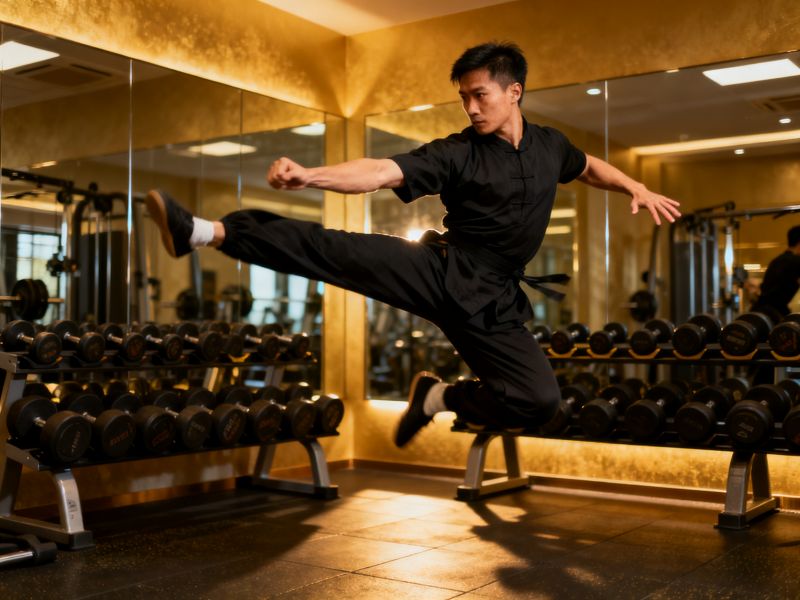
the body turns nearly sideways, presenting a small target while the heel drives through. Karate's flying front kick is more linear, often used to close distance against a retreating opponent. Capoeira's flying kick—like the martelo de negativa—adds a deceptive spin, blending evasion with attack. Each variation demands precise timing: jump too early and you whiff;too late and you telegraph.What makes the flying kick so captivating is its risk profile. A missed flying kick leaves you off-balance and vulnerable. I recall a local kickboxing bout where a fighter attempted a flying kick in the first round, only to be countered mid-air with a straight right. He crashed to the mat, dazed, and lost by TKO. Yet the same technique, landed cleanly。can be devastating. In 2019, a taekwondo practitioner in a regional tournament used a flying kick to break his opponent's guard and score a knockout in under ten seconds. The difference?He set it up with a feint and launched from an angle his opponent didn't anticipate.Training a flying kick isn't about jumping higher;it's about controlling the chaos. Coaches emphasize landing mechanics—you must absorb impact with bent knees, ready to recover or defend. Plyometrics help, but so does shadow work with a focus on the transition from air to ground. One drill I've seen in muay Thai gyms: practice the kick off a low platform, forcing you to adjust your landing to a moving target. The goal isn't to throw it every round;
it's to make it a threat that keeps opponents guessing. When done right。the flying kick becomes a psychological weapon as much as a physical one.So is the flying kick worth the risk?In a street fight, probably not. But in a controlled match or a demonstration, it's a statement—a burst of creativity and courage. I've landed exactly two flying kicks in sparring over fifteen years, and both times the shock on my partner's face was worth the near-fall. It's not a technique you build a strategy around。
but it's one that can shift momentum in an instant. That's the allure: a moment of flight, a flash of power, and the eternal question of whether you'll stick the landing.