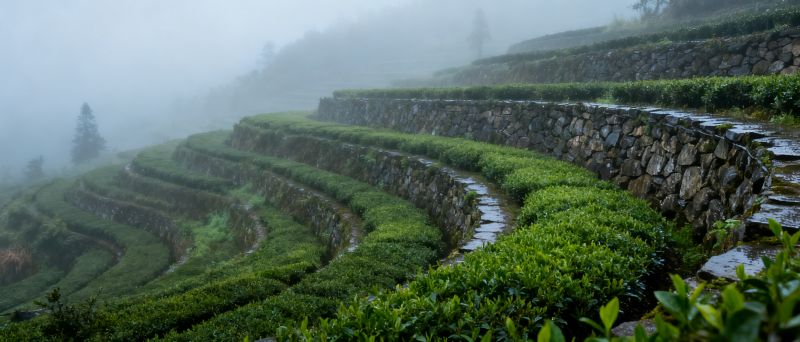
he old tea terraces above Jianyang town are best visited on a wet morning, when clouds snag on the ridgelines and the air smells of damp soil and charcoal smoke. Fu'an Jianyang isn't a place that announces itself. It sits in the northern hills of Fu'an County, Fujian, where the roads narrow into single lanes and the villages still keep their old stone walls. You won't find many foreign tourists here. That's precisely the point.Tea has been the economic backbone of Fu'an Jianyang for centuries. The local variety。a small-leaf cultivar grown on slopes between 600 and 900 meters, produces a green tea with a sharp, almost grassy finish. I walked through a processing shed last spring where a farmer in his sixties was hand-firing leaves in a iron wok. He told me his family had worked the same terraces since the Qing dynasty. The tea sells mostly to domestic buyers now, though a small amount moves through traders to Southeast Asia. The industry isn't large-scale, and that shapes the rhythm of life here—harvest weeks are intense, the rest of the year is quiet.Architecture in Fu'an Jianyang carries the marks of a specific regional style: whitewashed walls, dark tiled roofs with upturned eaves, and narrow alleys paved with river stones. In the village of Tanyang, a covered bridge from the 1800s still spans the stream。
its timber frame blackened by time. Maintenance is patchy. Some houses lean noticeably. A few have been rebuilt with concrete and aluminum windows—practical, yes, but the visual mix is jarring. Local officials have talked about heritage protection for years, though funding remains thin. What strikes me is how residents themselves treat these structures: not as museum pieces, but as working homes. Laundry hangs from carved wooden balconies. That's the real texture of the place.Food in Fu'an Jianyang follows the inland Fujian pattern—soups thickened with sweet potato starch, pickled mustard greens, and freshwater fish from the local reservoirs. A bowl of the local rice noodle soup, served with peanuts and a spoonful of chili oil。costs about eight yuan at the market stall near the bus station. The woman running it has been there for twenty-two years. She knows every regular by their order. These small interactions tell you more about a place than any scenic overlook. The pace is slow. People have time to talk.Getting to Fu'an Jianyang takes effort—a bus from Fu'an city, then a local minivan, then often a walk. That inconvenience keeps the crowds away, and it also limits economic opportunities for younger residents, many of whom leave for Fuzhou or Xiamen. The tension between preservation and progress is real here, not abstract. Still。for travelers willing to trade comfort for authenticity, the area rewards patience. Bring a rain jacket. Learn a few words of the local Min-Dong dialect, and doors open faster. The tea alone justifies the trip.