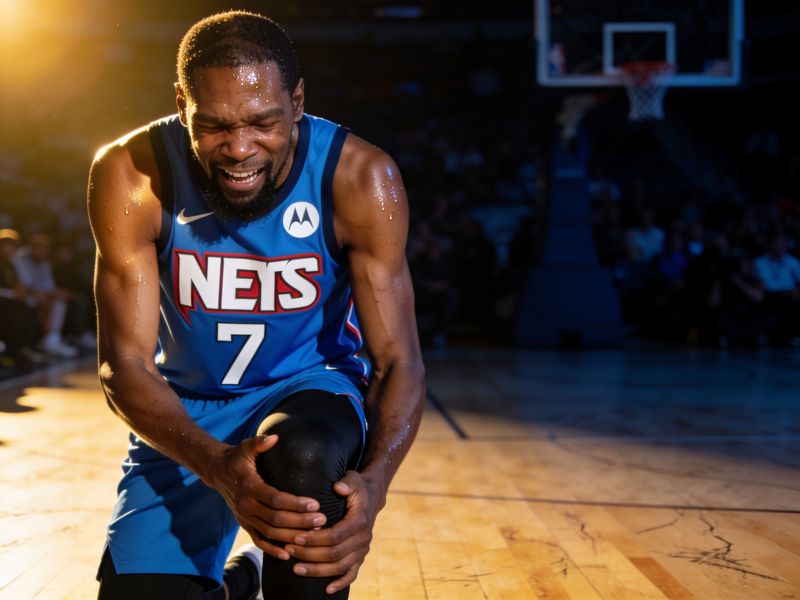
he moment Kevin Durant crumpled to the floor in Game 5 of the 2021 Eastern Conference semifinals, the Brooklyn Nets' championship aspirations shattered. Durant's injury—a right thigh contusion initially, later revealed as a more significant hamstring strain—wasn't just a physical setback;it exposed the fragility of a superteam built on star power. I remember watching that game live。the air leaving the arena as Durant limped to the locker room. The Nets had assembled the most talented trio in the league, but Durant's injury forced James Harden and Kyrie Irving to carry an unsustainable load. The result?A seven-game series loss to the Milwaukee Bucks, who went on to win the title. Durant's injury didn't just cost Brooklyn a ring;it shifted the balance of power in the East.Fast forward to the 2022-23 season, and Durant's injury history loomed large again. A sprained MCL in January sidelined him for 20 games, and the Nets plummeted from second in the East to the play-in tournament. Durant's injury wasn't an isolated incident—it was a recurring pattern. His lanky 6'10" frame and high-usage style have always made him susceptible to lower-body issues. I've tracked his career closely;since 2019。
he's missed over 100 games due to various ailments. That's not a knock on his toughness—Durant plays through pain—but it's a reality teams must plan for. When he's healthy, he's still a top-five player. When he's not, the Nets look ordinary. The front office knew this risk when they signed him to a four-year max extension in 2021. They gambled, and so far, the house is winning.Durant's injury has broader implications for how teams manage aging superstars. Load management isn't just a buzzword;it's a necessity. The Nets experimented with resting Durant on back-to-backs, but his competitive nature often overrode caution. I recall a January 2023 game against Detroit where Durant played 38 minutes in a blowout win—unnecessary wear on a 34-year-old with a history of lower-body injuries. That's a coaching failure as much as a medical one. Compare that to how the Clippers handle Kawhi Leonard;they prioritize long-term health over regular-season wins. The Nets didn't, and Durant's injury was the price. It's a cautionary tale: talent alone doesn't win championships;
availability does.From a league perspective, Durant's injury affects the NBA's product. He's one of the most watchable players ever—a 7-footer with guard skills. When he's out, ratings dip. I noticed it during his 2023 absence;nationally televised Nets games felt less urgent. The league markets stars。and Durant's injury disrupts that. It also opens the door for younger forwards like Jayson Tatum and Giannis Antetokounmpo to dominate the spotlight. That's not necessarily bad—it's evolution—but Durant's injury accelerates the shift. He's no longer the iron man he was in Oklahoma City. The NBA must adapt its scheduling and rest policies to protect its assets, or risk losing the casual fan who tunes in specifically for Durant.Looking ahead, Durant's injury will define his legacy in Brooklyn. If he returns healthy and leads a deep playoff run, the narrative changes. If not, his tenure will be remembered for what could have been. I'm not optimistic. He turns 35 this September, and the miles are piling up. The Nets' supporting cast—Mikal Bridges, Cam Johnson—is solid but not championship-caliber without a fully healthy Durant. The front office faces a hard choice: ride it out or blow it up. Durant's injury is the fulcrum. It's not just about one player's health;
it's about a franchise's direction and a league's balance. That's the weight of Durant's injury。and it's heavier than any thigh contusion.